Seller of record · payment orchestration
One seller of record.
Every acquirer behind it.
We sell your digital product under a supply agreement, route each payment to the acquirer that clears it best, and own the invoices, refunds and disputes. You integrate one API and get one negotiated margin.
Why teams move off a direct PSP
One margin instead of a stack of surcharges
A direct PSP account bills processing, cross-border cards, currency conversion, billing and tax tooling as separate lines. We quote one number that covers all of it.
No single-account dependency
Your checkout does not hang on one PSP account. Acquirers are connected, weighted and replaced on our side. Your integration never changes.
The seller's work is ours
Buyer invoices, tax treatment on every line, refunds, chargebacks, first-line buyer support and charge lookups are Pandycon's job, under Pandycon's policy.
Economics
What you pay all-in today
Set your numbers and see one all-in figure for a standard direct stack. That is the number we quote against — and come in under.
Your all-in cost on a direct stack
That is the all-in cost of a direct stack — before disputes, FX spread and engineering time. Pandycon quotes one rate against it, and it comes in lower.
An estimate for a standard direct stack — card processing, the fixed per-payment fee, typical cross-border and currency costs, and billing and tax tooling, rolled into one rate. Your real number depends on your mix, which is why we quote against your actual statement rather than this estimate.
How the models differ
| Direct PSP account | Flat-rate merchant of record | Pandycon | |
|---|---|---|---|
| Seller on the invoice | You, with every obligation that follows | The merchant of record | Pandycon, under a supply agreement with you |
| Acquirers behind checkout | One | Not disclosed | A router built for several; adding one changes nothing in your code |
| Pricing | List rate plus surcharges per line | One published rate for everyone | One margin, negotiated per supplier against your current bill |
| Money visibility | PSP dashboard and exports | Payout reports | Double-entry ledger: every order traces to balanced postings |
| Settlement | PSP payout schedule | Fixed schedule | On your agreed schedule or on request, with a purchase invoice each time |
| Integration | The PSP's SDK and concepts | Their checkout and API | One REST API and a Node SDK; no PSP concepts to learn |
How it works
Supply agreement
We review your product, sign a supply agreement and fix your margin. Your purchase price is retail × (1 − margin), written down and effective-dated.
One integration
Create products, payment links, checkout sessions and subscriptions through one API. Test keys run the whole flow in a sandbox.
Buyers pay Pandycon
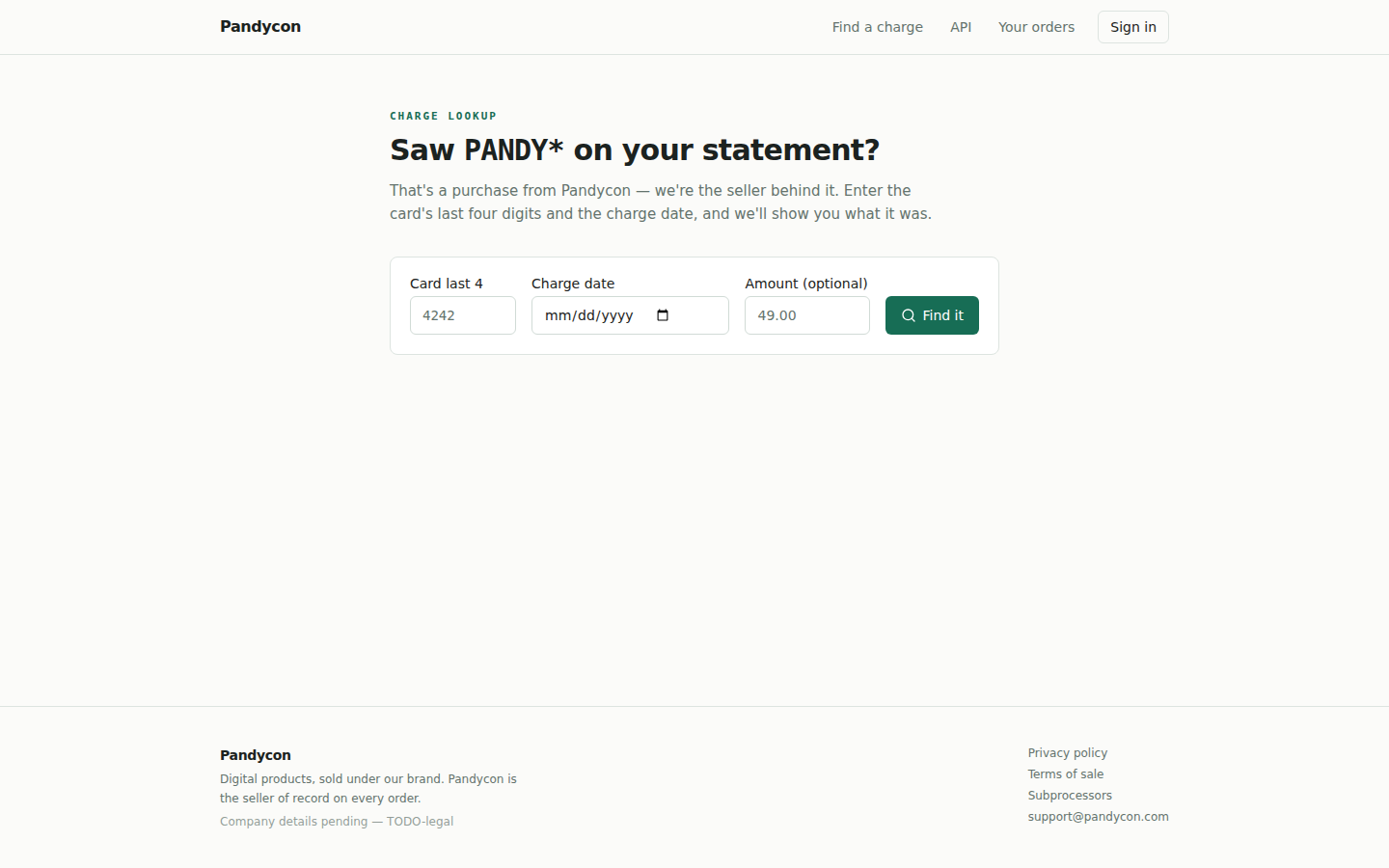
Checkout is hosted by us. The router picks the acquirer, 3‑D Secure applies where required, and the statement reads PANDY* YOURSITE.COM so buyers recognise the charge.
Payables settle
Every paid order accrues payables you can see live. Settlement runs on your schedule or on request, and each one comes with a purchase invoice.
See the product
Real screens, not mockups
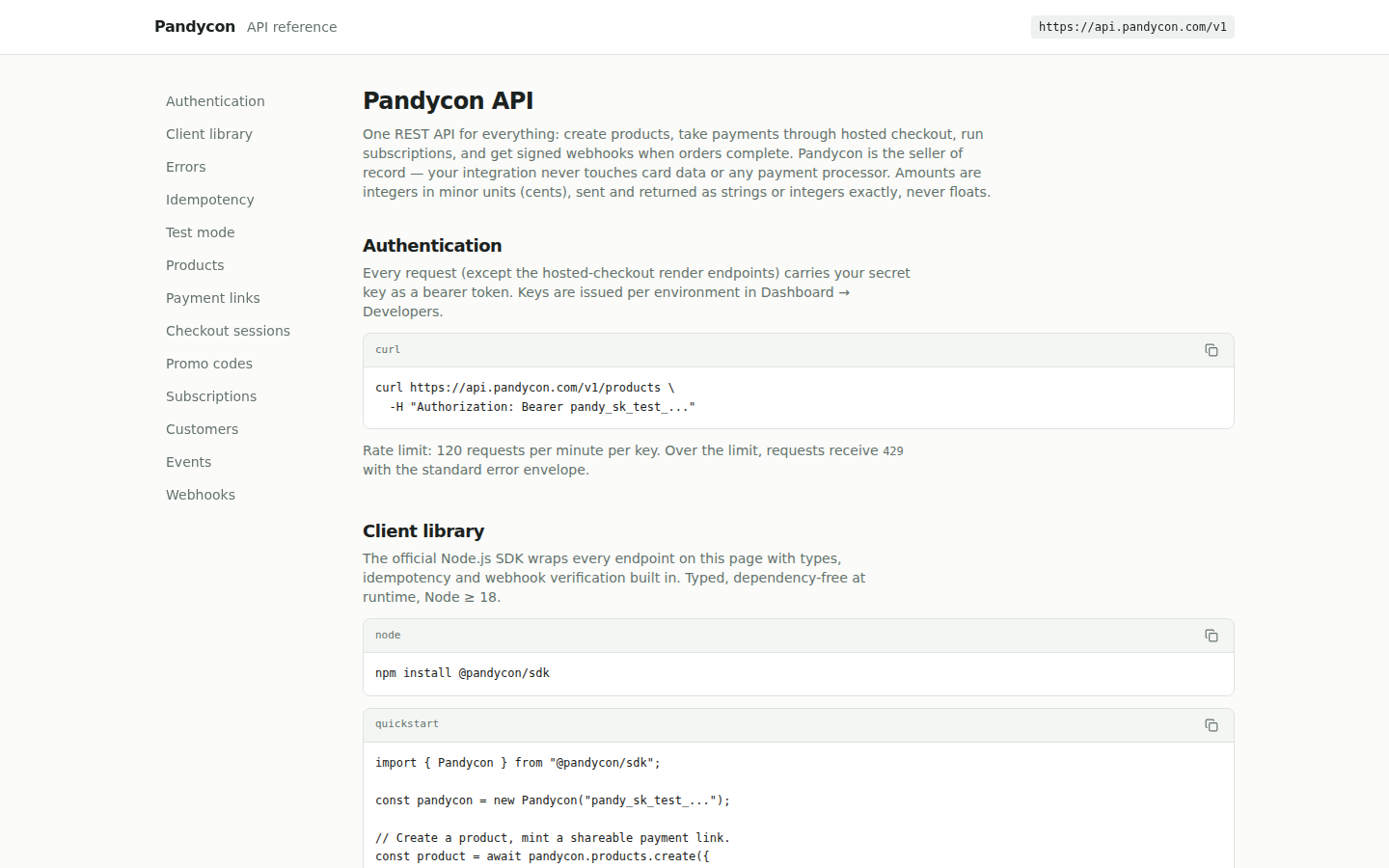
What you and your buyers actually get — the live developer docs and the charge-lookup page every buyer can reach from their statement.
What is in the box
Fit
A good fit
- SaaS and subscription products sold to buyers in several countries
- Courses, tools and other digital goods with a clear delivery moment
- Teams already processing through a direct PSP who want a lower all-in cost and fewer obligations
Not a fit
- Physical goods and anything that ships
- Marketplaces that pay out third-party sellers
- Products we cannot stand behind as the seller
FAQ
Is Pandycon a payment gateway?
No. Pandycon is the seller of record: we purchase your digital service under a supply agreement and sell it to the buyer under our terms. Payment routing is how we run our own checkout well, not a service we resell.
How is my margin set?
Individually. It depends on your volume, average order, buyer geography and refund history. Send us a recent processing statement and we quote one number against it. Terms are effective-dated and never change retroactively.
Who handles refunds and chargebacks?
Pandycon does, under one published policy. A refund or chargeback on an order reduces the payables accrued for it, as set out in your supply agreement.
What about sales tax and VAT?
As the seller, Pandycon issues the buyer's invoice and resolves the tax treatment of each line from the product category and the buyer's location. We monitor registration thresholds per jurisdiction. Ask us how your category is treated before you sign.
When do I get paid?
Payables accrue as orders are paid. Settlement runs on the schedule in your terms (weekly, biweekly or monthly) or on your request above the agreed minimum, after approval on our side.
Do I have to move everything at once?
No. Onboarding is per project. Most teams start with one product or one market and keep the rest where it is until the numbers are clear.
Send us last month's processing statement
We will come back with one margin, the settlement terms and an honest answer on whether moving makes sense for you.
suppliers@pandycon.com
Onboarding is by invitation. Each supplier is reviewed before the first sale.